


Image Source: pexels
You see strict quality standards shape the manufacturing of each transformer iron core. Leading organizations use IEEE, IEC, and DOE energy efficiency guidelines. Ouxu Electric invests in research, patents, and automated lines to deliver reliable products. You benefit from precise material selection and advanced designs that lower energy loss and noise. These cores support power grids, industry, homes, and renewable energy—meeting your need for efficiency and stability.
Key Takeaways
Transformer iron cores use high-permeability silicon steel to enhance efficiency and reduce energy loss.
Laminated construction minimizes eddy currents, leading to cooler operation and longer transformer life.
Choosing a custom transformer core allows you to meet specific voltage and noise requirements for your project.
Adhering to IEC and IEEE standards ensures your transformer core meets safety and performance benchmarks.
Regular inspections and maintenance help extend the life of your transformer and prevent unexpected failures.
Transformer Iron Core Basics
Definition and Function
You encounter the transformer iron core at the heart of every transformer. This core consists of thin silicon steel laminations, which possess high magnetic permeability. You benefit from these materials because they create a low reluctance path for the magnetic field. The iron core enables voltage induction between the primary and secondary windings. Laminated construction helps you reduce eddy current losses, which improves efficiency and keeps the transformer cool.
The transformer iron core uses highly permeable silicon steel sheets.
It forms a low reluctance path for magnetic fields.
Laminations minimize eddy current losses and boost efficiency.
Tip: Choosing a laminated iron core helps you achieve lower energy loss and longer transformer life.
Role in Transformer Performance
You rely on the transformer iron core to enhance magnetic coupling between coils. This feature allows efficient energy transfer from the primary to the secondary winding. Laminated sheets in the core construction help you minimize overheating and circulating currents. You see improved efficiency and reliability because the core reduces energy losses. The transition from solid iron to silicon steel has made transformers more dependable and effective.
The iron core increases magnetic coupling for better energy transfer.
Laminated sheets prevent overheating and reduce losses.
Silicon steel cores deliver higher reliability and efficiency.
You notice that the transformer iron core directly impacts performance metrics such as efficiency, reliability, and operational stability. When you select a high-quality core, you ensure your transformer operates smoothly and meets demanding energy standards.
Materials for Transformer Iron Core
CRGO Silicon Steel Overview
You need to choose the right material for your transformer iron core to achieve high efficiency and reliability. Manufacturers use several materials, each with unique properties. The table below shows the main materials and their key features:
Material | Key Properties |
|---|---|
Iron | High permeability, low hysteresis loss, high saturation flux density, abundant and cost-effective. |
Steel | Higher electrical resistance leading to greater eddy current losses, more expensive than iron. |
Amorphous metal alloys | Extremely low hysteresis losses, non-crystalline structure, but high manufacturing costs limit use. |
Ferrite | Suitable for high-frequency applications, offers size and weight advantages, less efficient at lower frequencies. |
You see that Cold Rolled Grain Oriented (CRGO) silicon steel stands out for transformer iron core applications. This material offers you several advantages:
High magnetic permeability in the rolling direction
Ideal for power and distribution transformers
Increased electrical resistivity reduces eddy currents
Reduced core heating enhances operational efficiency
Improved magnetic saturation allows for higher flux densities
Better surface stability prevents oxidation and corrosion
You benefit from these properties because they help your transformer run cooler, quieter, and more efficiently.
Ouxu Electric’s Custom Iron Core Features
You can select a transformer iron core from Ouxu Electric that matches your exact needs. Ouxu Electric uses high-permeability CRGO silicon steel sheets and advanced manufacturing techniques. You get options for core diameter, winding height, and oil tank length. The table below highlights some customization aspects:
Customization Aspect | Details |
|---|---|
Reference Standards | GB/T 1094.1-2013, EN 60076-1, DIN 50021 |
Iron Core Diameter | Reduced from 1.2m to 1.05m using high-permeability silicon steel sheets |
Winding Height | Lowered to 1.8m with a double-layer winding technique |
Oil Tank Length | Shortened from 4.2m to 2.8m, with a corrugated structure replacing the traditional radiator |
You can request a core with a full miter joint laminated design, burr-free treatment, and high insulation class. These features help you reduce noise, energy loss, and maintenance costs. Ouxu Electric’s transformer iron core adapts to different voltage levels and installation environments, giving you flexibility for your project.
Note: Choosing a custom core from Ouxu Electric ensures you meet international standards and achieve long-term reliability.
Manufacturing Process Overview
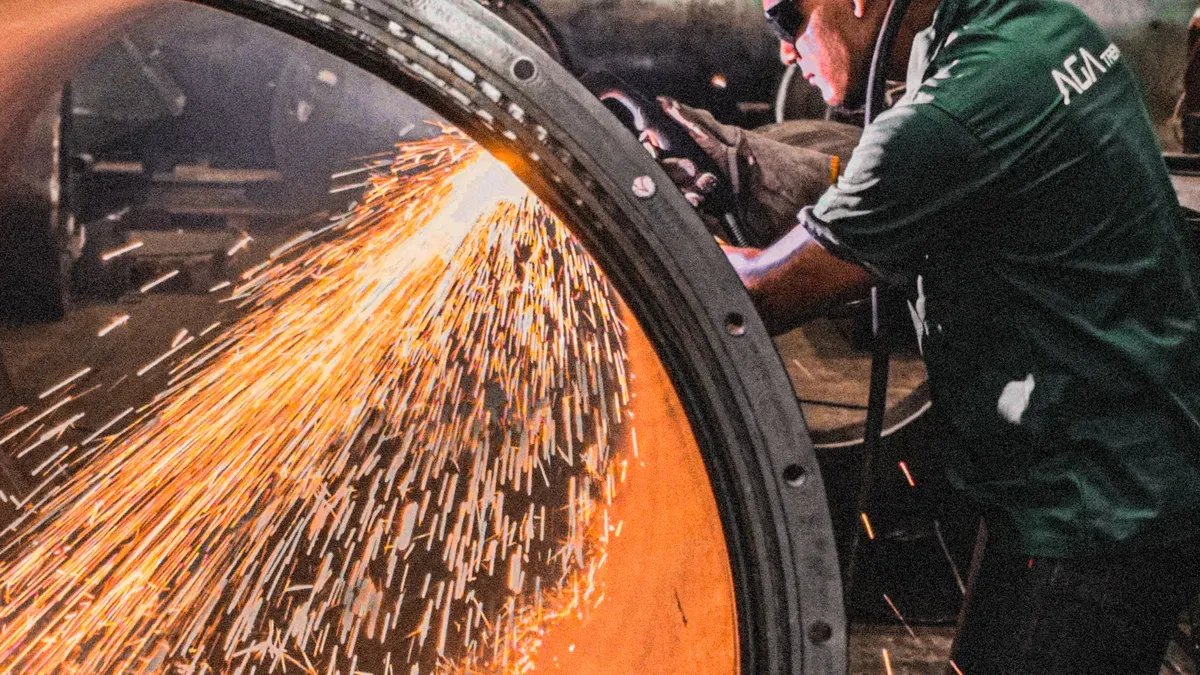
Image Source: pexels
You need to understand how manufacturers create a high-quality transformer iron core. The process involves several precise steps. Each step ensures the core meets strict standards for efficiency, durability, and performance.
Material Inspection
You start with raw material preparation. Manufacturers select premium silicon steel sheets because these sheets offer high magnetic permeability and low energy loss. Quality inspection is essential at this stage. You see technicians use advanced tools to check for thickness, surface defects, and uniformity.
Description | |
|---|---|
Hysteresis Loss Testing | Measures how much energy the core loses during magnetization cycles. |
Magnetic Flux Density Testing | Checks the core's ability to carry magnetic fields. |
Visual Inspection | Confirms there are no cracks, rust, or surface defects. |
You also find other tests, such as Epstein frame testing for core loss, digital micrometers for thickness, and interlamination resistance checks. These tests ensure only the best materials move to the next stage.
Tip: Careful material inspection helps you avoid future failures and keeps your transformer running efficiently.
Lamination and Assembly
You move to the lamination process. Manufacturers slice the silicon steel into thin sheets, usually between 0.25mm and 0.50mm thick. Each sheet receives a special non-conductive coating. This coating blocks electrical currents that could cause energy loss.
Laminated sheets create smaller loops for eddy currents, which improves efficiency.
The use of 45° miter joints reduces magnetic flux leakage and boosts performance.
Thinner laminations increase resistance to circulating currents, lowering power loss.
You see that stacking and fastening the sheets require precision. Workers align the sheets carefully to maintain insulation and avoid gaps. The number of layers and the quality of assembly directly affect the core’s efficiency. If you use more layers, you reduce eddy current waste and keep the transformer cooler.
The lamination process also protects winding insulation from heat damage. This step extends the life of your equipment.
Treatments and Finishing
You reach the final stage—treatments and finishing. Manufacturers apply insulation treatments to prevent short circuits between the silicon steel sheets. They use insulating paint or paper for this purpose. Protective coatings, such as corrosion-resistant and antioxidant layers, shield the core from moisture and oxidation.
These finishing treatments help you achieve long-lasting performance. The core resists aging, heat, and environmental damage. You benefit from a transformer that operates quietly and efficiently for many years.
Note: Proper finishing treatments are essential for durability and safety in every transformer iron core.
By following these steps, you ensure your transformer iron core meets international standards and delivers reliable service in demanding environments.
Quality Standards and Testing
Image Source: pexels
International Standards (IEC, IEEE)
You need to know which standards guide the quality of transformer iron cores. International organizations set strict rules to ensure safety, performance, and reliability. The International Electrotechnical Commission (IEC) and the Institute of Electrical and Electronics Engineers (IEEE) are the main bodies that define these requirements.
Standard | Description |
|---|---|
IEC 60076-1 | |
IEC 60076-3 | Dielectric tests (impulse, induced voltage) |
IEC 60076-11 | Dry-type transformer special tests |
IEEE C57.12.90 | Testing procedures for liquid-immersed transformers |
You see that these standards cover everything from design to testing. IEC 60076 series applies globally, setting rules for both power and dry-type transformers. IEEE C57.12 series focuses on North American practices, especially for liquid-immersed and dry-type units.
Standard | Organization | Scope |
|---|---|---|
International Electrotechnical Commission | Power and dry-type transformer design/testing | |
IEEE C57.12 series | Institute of Electrical and Electronics Engineers | North American standards for transformers |
You benefit from these standards because they ensure your transformer iron core meets strict requirements for insulation, loss, and mechanical strength. Manufacturers must follow these rules to guarantee safe operation and long service life.
Tip: Always check for IEC or IEEE compliance when you select a transformer iron core. This step helps you avoid unexpected failures and ensures your equipment meets global benchmarks.
Ouxu Electric’s Quality Control Practices
You expect more than just compliance with international standards. Ouxu Electric goes beyond basic requirements by investing in research, patents, and advanced testing. The company holds dozens of patents and has contributed to multiple industry standards, showing leadership in transformer iron core innovation.
You see Ouxu Electric’s quality control practices in every step of production. The technical team uses automated inspection tools to check for core loss, insulation resistance, and mechanical strength. Each transformer iron core undergoes:
Hysteresis loss testing
Magnetic flux density measurement
Visual inspection for burrs and defects
Dielectric and impulse tests
You receive products that meet or exceed IEC and IEEE standards. Ouxu Electric’s rigorous testing ensures low noise, minimal energy loss, and stable operation. The company also provides detailed acceptance guidance and bilingual manuals for installation. You get regular follow-up visits and maintenance reminders, which help you keep your equipment running smoothly.
Note: Ouxu Electric’s after-sales support includes paid maintenance plans, remote technical guidance, and fast response to acceptance issues. This service helps you avoid downtime and extends the life of your transformer.
You can explore Ouxu Electric’s quality-focused products, such as custom transformer iron cores, and learn more about their customer service approach. These resources show how Ouxu Electric delivers reliable solutions for power engineering and industrial manufacturing.
Callout: Ouxu Electric’s achievements in patents and industry standards set a benchmark for quality. You gain confidence knowing your transformer iron core comes from a company that leads in innovation and customer satisfaction.
Transformer Iron Core Types and Comparison
Laminated vs. Toroidal Cores
You encounter two main types of transformer iron cores: laminated and toroidal. Laminated cores use stacked sheets of magnetic material. These sheets reduce eddy currents and improve efficiency. Toroidal cores use a continuous strip of magnetic material wound into a ring shape. This design creates a closed magnetic circuit and minimizes flux leakage.
Feature | Laminated Core | Toroidal Core |
|---|---|---|
Construction | Stacked flat sheets | Continuous wound strip |
Magnetic Path | Multiple paths | Single closed path |
Efficiency | Good for most uses | Excellent, low losses |
Noise | Moderate | Lower |
Manufacturing Cost | Lower | Higher |
Application | Power, distribution | Compact, low-noise |
You see that laminated cores work well in power and distribution transformers. Toroidal cores fit best in compact designs and noise-sensitive environments.
Tip: Choose toroidal cores when you need low electromagnetic interference and high efficiency.
Manufacturing Differences
You notice clear differences in how manufacturers produce these cores.
Laminated cores use thin sheets of silicon iron or nickel iron. Workers roll, stamp, and glue these sheets together. Insulation sits between layers to block eddy currents.
Toroidal cores require winding a continuous strip of magnetic material into a doughnut shape. This process creates a closed magnetic circuit and reduces flux leakage.
Laminated cores offer a simpler manufacturing process. You benefit from lower costs and faster production. Toroidal cores need more complex winding and careful handling. This increases costs and lead times but delivers better magnetic properties.
Shell transformer cores provide low magnetic resistance and high flux density. You find them efficient for medium to high voltage applications. Amorphous alloy cores deliver extremely low losses and high energy efficiency. These cores suit noise-sensitive applications but cost more to produce.
Core Type | Advantages | Limitations |
|---|---|---|
Shell Cores | Low magnetic resistance, high flux | Complex manufacturing, careful winding |
Amorphous Alloy | Extremely low losses, high efficiency | Higher cost, complex cooling |
You select the right transformer iron core by considering your application, efficiency needs, and budget.
Performance and Application Insights
Efficiency and Loss Reduction
You want your transformer to run efficiently and save energy. Several factors influence how well your transformer iron core performs:
Core material selection, such as grain-oriented silicon steel or amorphous metals
Operating frequency and flux density
Core geometry and construction techniques
When you use advanced materials and optimized designs, you see lower energy losses and better performance. Proper selection of operating flux density also helps you reduce wasted energy.
Here is a table showing typical no-load loss values for transformer iron cores in industrial applications:
Transformer Rating | Voltage (kV) | No-Load Loss (W) | Iron Loss % of Full Load |
|---|---|---|---|
100 kVA | 11/0.4 | 300–500 | 1.5–2% |
500 kVA | 11/0.4 | 800–1200 | 1.2–1.5% |
2.5 MVA | 33/11 | 2500–3500 | 0.8–1.2% |
40 MVA | 132/33 | 15,000–18,000 | 0.3–0.6% |
You benefit from reduced energy consumption, improved efficiency, and lower maintenance costs when you choose high-quality transformer iron cores. These cores also offer enhanced safety features and maintenance-free operation with a low failure rate.
Ouxu Electric Solutions and Case Studies
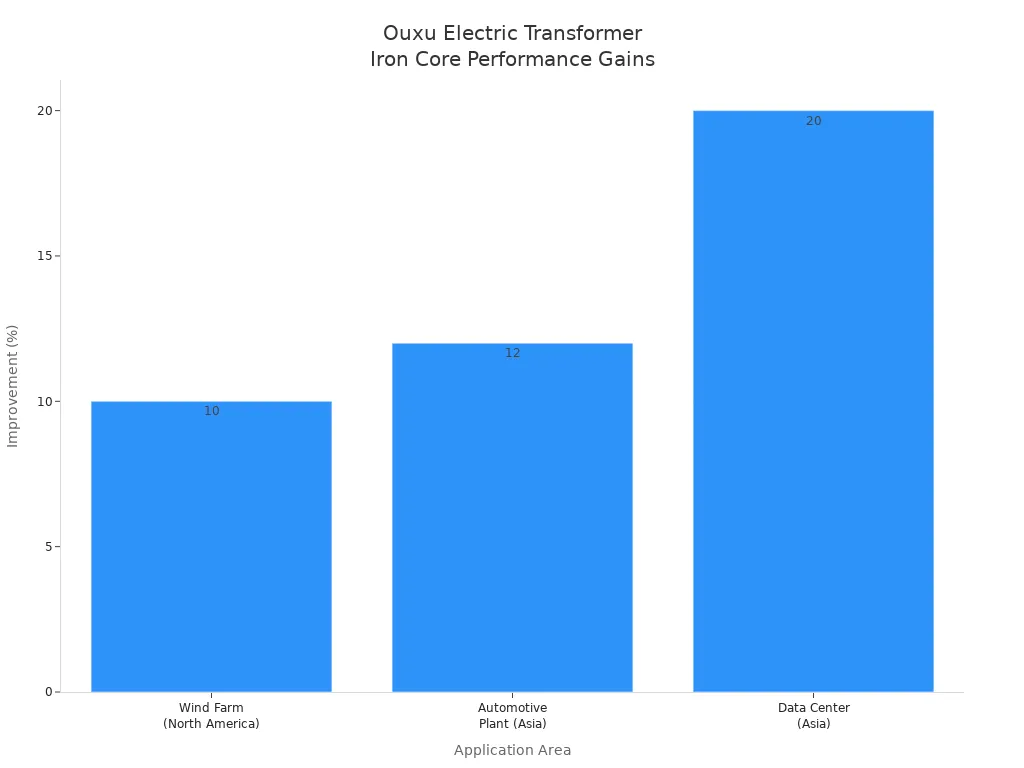
You see real-world results when you use Ouxu Electric’s transformer solutions. The company customizes each core to fit your needs, whether you run a wind farm, automotive plant, or data center. Here are some outcomes from actual projects:
Application Area | Outcome Metrics |
|---|---|
Wind Farm (North America) | 10% boost in overall system efficiency |
Automotive Plant (Asia) | 12% reduction in energy costs |
Data Center (Asia) | 20% decrease in energy consumption |
Metro System (Europe) | Higher energy efficiency and reliability |
You can see these benefits in action. For example, a European auto parts factory used a custom transformer from Ouxu Electric. The solution saved space, reduced noise, and met strict energy standards. You gain reliable power, lower costs, and peace of mind with Ouxu Electric’s support and maintenance services.
Tip: Choose a transformer iron core designed for your application to maximize efficiency and long-term value.
You see that precise manufacturing and strict quality standards guarantee reliable transformer iron core performance. Automated production lines and adherence to IEC and IEEE standards protect your equipment and ensure long-term stability. Ouxu Electric advances technology through innovation and delivers solutions that meet your needs. Explore Ouxu Electric’s transformer iron core products or contact us to prioritize quality and innovation in your next project.
FAQ
What is the main material used for transformer iron cores?
You usually find Cold Rolled Grain Oriented (CRGO) silicon steel as the main material. This steel offers high magnetic permeability and low energy loss, making your transformer more efficient and reliable.
How does lamination improve transformer core performance?
You benefit from lamination because it reduces eddy currents. Thin, insulated sheets block unwanted currents, which lowers heat and energy loss. This process helps your transformer run cooler and last longer.
Why should you choose a custom transformer iron core?
You get a core that matches your voltage, size, and noise requirements. Customization lets you optimize efficiency, reduce losses, and ensure the core fits your installation space perfectly.
How do you know if a transformer iron core meets quality standards?
You should check for IEC or IEEE certification. These standards guarantee that your core has passed strict tests for safety, efficiency, and durability.
What maintenance does a transformer iron core need?
You need to schedule regular inspections for rust, noise, and overheating. Cleaning and checking for loose laminations help you prevent failures and extend the core’s service life.