


Image Source: unsplash
You need to consider technical parameters when selecting a three phase transformer. Factors like voltage class, power capacity, and mounting configuration affect performance, safety, and cost. For example, efficiency standards and impedance ratings help you achieve operational savings and reliable voltage regulation. Ouxu Electric applies advanced research to create innovative transformer solutions, trusted by clients worldwide. Market data shows stationary transformers hold 45.8% share, highlighting how mounting choices and technical details shape industry trends.
Mounting Configuration | Market Share in 2025 | Market Revenue (approx.) |
|---|---|---|
Stationary | 45.8% | $10.3 billion |
Pad-Mounted | 33.2% | N/A |
Pole-Mounted | 21.0% | N/A |
Key Takeaways
Understand rated capacity and voltage to prevent transformer overload and ensure stable operation.
Choose the right cooling method based on your environment to maintain efficiency and extend transformer life.
Match the transformer’s impedance and losses to improve voltage regulation and reduce operational costs.
Check compliance with international standards to guarantee safety and reliability in transformer performance.
Consider customization options from Ouxu Electric to meet specific project needs and enhance operational efficiency.
Three Phase Transformer Overview
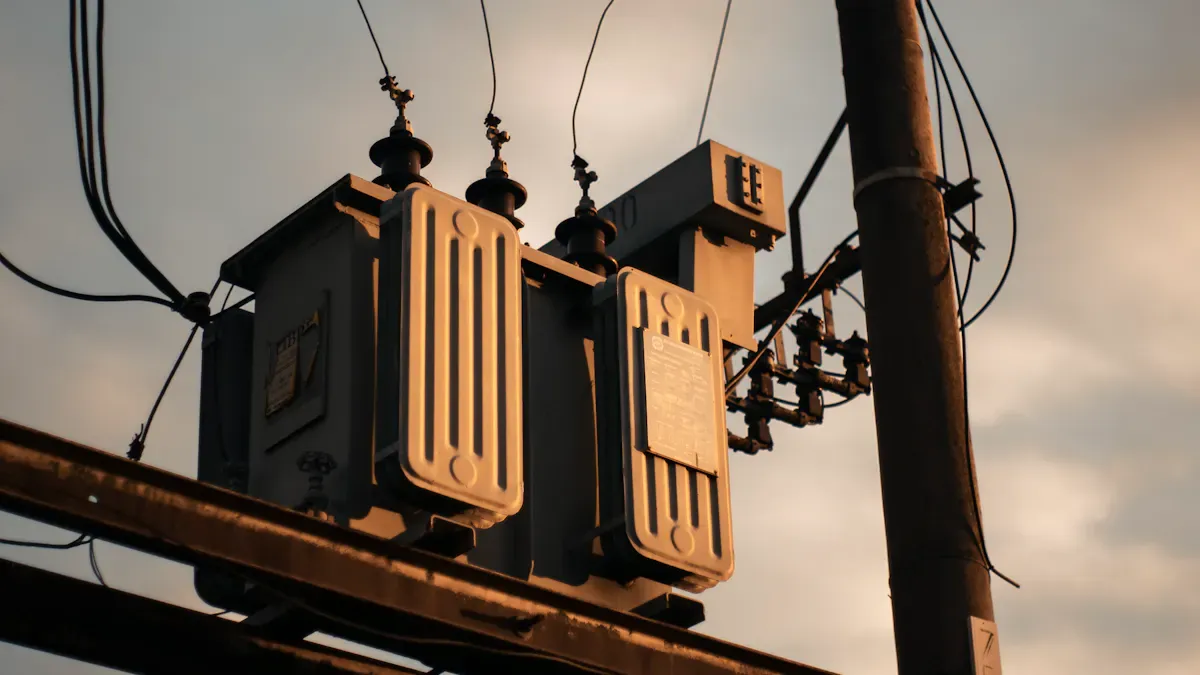
Image Source: pexels
What Is a Three Phase Transformer
You encounter a three phase transformer in many power systems. This device transfers electrical energy between circuits using electromagnetic induction. Each phase operates 120 degrees apart, which keeps current flow steady. The primary winding receives power from a three-phase supply and creates a magnetic field in the iron core. The core has three limbs, and two limbs act as a return path for the flux in the third limb. The secondary winding receives induced voltage based on the transformation ratio. The working principle follows Faraday’s law of electromagnetic induction. Alternating current in the primary coil produces a changing magnetic field, which links to the secondary coil and generates a new voltage. This design allows efficient energy transfer and reduces power losses. You benefit from voltage stability in industrial and electrical networks.
Applications and Importance
You rely on three phase transformers in many sectors.
Power Distribution: Step down high-voltage electricity for safe use.
Industrial Applications: Supply power to heavy machinery in manufacturing and mining.
Renewable Energy Integration: Convert varying output voltages from wind and solar farms.
HVAC Systems: Provide power for efficient building operation.
Data Centers: Ensure stable power for critical equipment.
Railway Systems: Power electric trains and traction motors.
Oil and Gas Industry: Support drilling equipment and refining processes.
Motor Control: Regulate speed and direction for motors.
You see these transformers in electrical utilities, industrial plants, and power generation facilities. They maintain operational continuity and support uninterrupted power supply systems. Their role is critical for voltage adjustment during transmission and for connecting renewable energy systems to the grid.
Ouxu Electric’s Role in the Industry
You notice Ouxu Electric stands out in the three phase transformer market. The company invests 8% of annual sales in research and development. It holds dozens of patents and develops industry standards. Ouxu Electric focuses on quality, innovation, and customer satisfaction. The company produces dry type amorphous alloy transformers and other advanced products. You benefit from strict compliance with efficiency and safety standards.
Feature | Ouxu Electric | Other Leading Manufacturers |
|---|---|---|
Commitment to Quality | High | Varies |
Investment in R&D | 8% of annual sales | Typically lower |
Patents and Industry Standards | Dozens of patents | Fewer patents |
Product Efficiency Standards | Strict compliance | Varies |
Innovation in Product Development | Standard transformers | |
You gain access to innovative solutions and reliable products when you choose Ouxu Electric. The company’s dedication to research and quality ensures you receive transformers that meet modern demands. |
Key Technical Parameters

Image Source: pexels
When you select a three phase transformer, you need to understand several technical parameters. These factors determine how well the transformer fits your application, how efficiently it operates, and how long it will last. Let’s break down each parameter and see how Ouxu Electric’s products address these needs.
Rated Capacity and Voltage
Rated capacity tells you how much power the transformer can handle safely, usually measured in kVA or MVA. Voltage class shows the maximum voltage the transformer can manage. Choosing the right values prevents overloading and ensures stable operation.
Voltage Class | Power Capacity Range |
|---|---|
Low Voltage | Up to 1kVA |
Medium Voltage | 1kV – 69kV |
High Voltage | 69kV – 230kV |
Extra High Voltage (EHV) | 230kV – 400kV |
Ultra High Voltage (UHV) | Above 400kV |
Distribution Transformers | 10kVA to 2.5MVA |
Substation Power Transformers | 3MVA to 100MVA |
Transmission Power Transformers | 100MVA to 500MVA |
Generation Transformers (GSU) | Up to 1000MVA or more |
You must match the transformer’s voltage rating to your system to avoid overvoltage or undervoltage problems.
Correct capacity prevents overheating and energy waste.
Voltage rating also affects impedance and voltage regulation.
For example, the Factory 10kV three-phase oil immersed on load tap changer transformer from Ouxu Electric offers a rated capacity from 200kVA to 2500kVA and supports high voltage levels of 6/6.3/10/10.5kV, making it ideal for both industrial and civil applications.
Current and Frequency
Current rating shows the maximum current the transformer can carry. Frequency, measured in hertz (Hz), must match your local power grid.
Region | |
|---|---|
Most countries | 50 |
About 40 countries | 60 |
If you use the wrong frequency, you risk damaging the transformer and increasing losses. Always check that the transformer’s frequency matches your system. For example, Ouxu Electric’s SCBH15-30-2500/10 Dry type amorphous alloy transformer operates at 50Hz, which fits most global standards.
If the frequency parameter doesn’t match, it can affect core losses and impedance of the unit, and it will age faster.
Impedance and Losses
Impedance, shown as a percentage (Z%), affects voltage regulation and limits fault currents during short circuits. Losses include core losses (from the magnetic field) and copper losses (from winding resistance). Lower losses mean higher efficiency and lower operating costs.
Application | Typical Z% | Selection Rationale |
|---|---|---|
Urban distribution | 4–6% | Voltage quality priority, adequate fault limiting |
Industrial feeders | 5–7% | Motor starting tolerance, higher fault limiting |
Generator step-up | 8–12% | Limit generator fault contribution |
Arc furnace supply | 10–15% | Control current fluctuation magnitude |
Ouxu Electric’s S20-M-30-2500/10-NX2 Grade 2 Energy Efficient Oil Smelted Transformer features an impedance of 4%-6% and reduces no-load loss by 20%, helping you save energy and improve reliability.
Efficiency and Cooling Methods
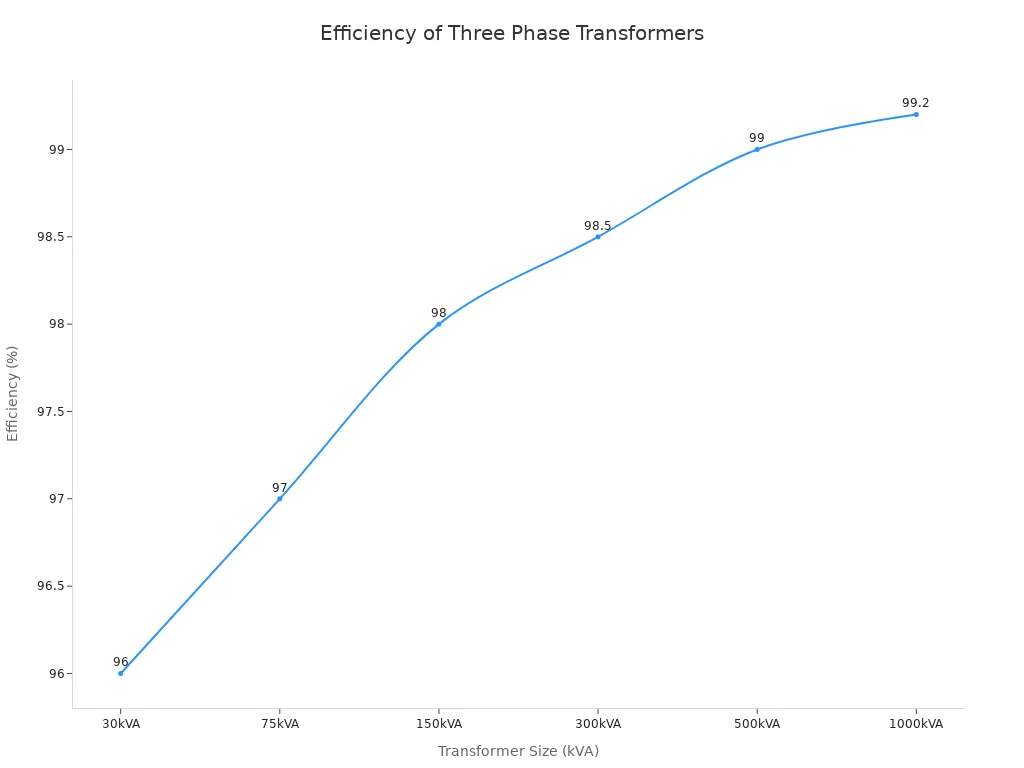
Efficiency measures how much input power is converted to useful output. Higher efficiency means less energy wasted as heat.
Efficiency | |
|---|---|
30kVA | 96% |
75kVA | 97% |
150kVA | 98% |
300kVA | 98.5% |
500kVA | 99% |
1000kVA | 99.2% |
Cooling methods keep the transformer at a safe temperature. Common types include:
Cooling Method | Oil Flow | Cooling Mechanism | Application |
|---|---|---|---|
ONAN | Natural | Heat dissipates through radiators | Small-Medium Transformers |
ONAF | Natural | Cooling fans enhance air circulation | Medium-Large Transformers |
OFAF | Forced | Oil pumps + fans | Large Transformers |
OFWF | Forced | Oil circulates through water-cooled heat exchangers | Extra-Large Transformers |
Ouxu Electric’s Power Distribution S13-M-30-2500/10 full hermetically sealed transformer uses ONAN cooling for reliable operation and offers high efficiency, reducing operational costs.
Insulation Class and Protection Level
Insulation class determines the maximum temperature the transformer can handle. Common classes include Class H (180°C) and Class R (220°C). Higher insulation classes mean better durability and longer life.
Protection level, such as IP54 or IP67, shows how well the transformer resists dust and water. For harsh environments, you need higher protection grades.
Protection Grade | Description |
|---|---|
C4 | High humidity, moderate salinity (industrial, coastal) |
C5-I/M | Extreme conditions (offshore, chemical plants) |
Ouxu Electric’s Urban commercial or rural household Amorphous Alloy Distribution Transformer SBH15-M-30-2500/10 features IP67 protection, making it suitable for outdoor and humid environments.
Winding Connection Group
The winding connection group affects system compatibility and performance. Common types include:
Connection Group | Description | Advantages |
|---|---|---|
Delta-Delta (Dd) | Both windings in delta | Handles unbalanced loads, continues with one failed unit |
Star-Star (Yy) | Both windings in star | Access to line-to-neutral voltages, high-voltage use |
Star-Delta (Yd) | Primary star, secondary delta | Reduces voltage stress, eliminates third harmonics |
Delta-Star (Dy) | Primary delta, secondary star | Neutral point, suppresses harmonics |
Ouxu Electric’s Wholesale 35kV double-winding on-load tap-changing oil-immersed power transformer offers YNd11 as standard, with other options for custom needs.
Noise and Environmental Adaptability
Noise level matters, especially in urban or sensitive areas. Distribution transformers usually produce 55–65 dB at 1 meter. Ouxu Electric’s SC(B)13-30-2500kVA/10kV epoxy resin cast dry-type transformer operates at ≤55 dB, meeting international standards.
Environmental adaptability means the transformer can handle extreme temperatures, moisture, dust, and chemicals.
Feature | Function |
|---|---|
Robust enclosure designs | Protects against moisture and physical damage |
Advanced cooling systems | Keeps transformer cool in high temperatures |
Cold-resistant materials | Prevents freezing in low temperatures |
Waterproof enclosures | Stops moisture from entering |
Dust-proof enclosures | Reduces dirt and overheating |
Corrosion-resistant materials | Lasts longer in harsh chemical environments |
Ouxu Electric’s products use robust enclosures and corrosion-resistant materials to ensure reliable performance in tough conditions.
Service Life and Standards
Service life shows how long you can expect the transformer to operate reliably. Most three phase transformers last 20–30 years or more with proper maintenance.
International standards, such as IEC 60076 and IEEE/ANSI, set requirements for design, testing, and safety.
Part | Title | Description |
|---|---|---|
IEC 60076-1 | General | Core definitions, ratings, and testing |
IEC 60076-2 | Temperature rise | Thermal performance under load |
IEC 60076-3 | Insulation levels and dielectric tests | High-voltage withstand and test protocols |
IEC 60076-10 | Determination of sound levels | Acoustic emission limits |
IEC 60076-11 | Dry-type transformers | Design and testing of air-cooled/dry units |
Ouxu Electric’s transformers comply with these standards, ensuring you receive safe, reliable, and high-quality products.
Tip: Always check for compliance with international standards when selecting a three phase transformer. This guarantees safety, performance, and long-term value.
If you want to explore more about transformer selection and see real-world applications, visit Ouxu Electric’s solutions page for detailed case studies.
Parameter Impact on Selection
Performance and Safety
You need to understand how technical parameters shape transformer performance and safety. These factors determine how well your system operates and how reliably it protects your equipment.
Voltage and power rating influence efficiency and heat dissipation.
Cooling methods help manage temperature and prevent overheating.
Electrical isolation and noise reduction features improve safety in sensitive environments.
The ability to handle overloads ensures your transformer operates safely during unexpected demand spikes.
For example, Ouxu Electric’s Factory 10kV three-phase oil immersed on load tap changer transformer uses advanced cooling and voltage regulation to maintain stable performance and protect against faults.
Suitability for Applications
You must match the transformer’s parameters to your specific needs.
Voltage requirements: Choose a transformer that meets your system’s voltage ratings. Different winding configurations, such as wye or delta, suit different load types.
Power requirements: Assess the total power your application demands. High-power systems need transformers that can handle large currents.
Cooling needs: Select a transformer with a cooling system that fits your operational environment.
Installation environment: Consider whether you need protection against moisture, dust, or physical damage for outdoor or harsh locations.
Ouxu Electric’s SCBH15-30-2500/10 Dry type amorphous alloy transformer offers IP54 protection and air self-cooling, making it suitable for indoor distribution networks and areas with strict fire safety requirements.
Ouxu Electric Product Examples
You can see how Ouxu Electric products address different selection criteria.
The Power Distribution S13-M-30-2500/10 full hermetically sealed transformer provides high energy efficiency and strong resistance to short circuits, ideal for industrial and commercial settings.
The Urban commercial or rural household Amorphous Alloy Distribution Transformer SBH15-M-30-2500/10 features IP67 protection and maintenance-free design, perfect for outdoor and humid environments.
The SC(B)13-30-2500kVA/10kV epoxy resin cast dry-type transformer meets international standards for noise and safety, making it a strong choice for hospitals, schools, and commercial centers.
Tip: When you select a Three Phase Transformer, always check product specifications and certifications to ensure the best fit for your application.
Selection Logic and Checklist
Load Assessment
You start by evaluating your current and future power needs. Follow these steps for a thorough load assessment:
Assess your present load and estimate growth based on expansion plans or technology upgrades.
Add a safety margin of 20% to 30% to cover unexpected increases in demand.
Choose a transformer that allows for scalability as your requirements change.
Select high-efficiency models to reduce operational costs.
Make sure the transformer can handle different load types for flexibility.
Tip: Using the 80% rule helps you avoid overloading. Operate your transformer at no more than 80% of its rated capacity for optimal reliability.
Voltage and Current Matching
You need to match voltage and current ratings to your system. Consider these points:
Input power equals output power, so the transformer must handle your system’s demands.
As voltage decreases, current increases. Make sure your wiring and transformer can support this change.
Impedance transformation lets you match high-impedance sources to low-impedance loads, which is important for specialized applications.
Environmental and Installation Factors
You must consider environmental and installation conditions:
Temperature: Transformers are rated for a daily average of 30°C. Higher temperatures require larger units or extra cooling.
Humidity: High humidity calls for corrosion protection and sealed designs.
Altitude: At higher altitudes, cooling efficiency drops, so you may need to derate the transformer.
Installation location: Outdoor units need weatherproof enclosures. Indoor units must control noise.
Space constraints: Compact designs fit tight spaces and allow for flexible mounting.
Note: Ouxu Electric offers transformers with robust enclosures and high protection levels. You can find more details about installation support on their service page.
Compliance and Certification
You must check compliance and certifications before making a decision. Review the following requirements:
Scope | Transformer Impact | Global Requirement | |
|---|---|---|---|
RoHS | Restricts hazardous materials | Materials in windings, coatings | Mandatory in EU, global |
REACH | Controls use of chemicals | Oils, paints, insulation | Mandatory in EU, global |
PCB-Free | Prohibits toxic insulating fluids | Requires eco-friendly fluids | UN & national laws |
Ouxu Electric’s products meet international standards and certifications, ensuring safe and reliable operation.
Final Checklist
Before you select a Three Phase Transformer, review this checklist:
Confirm voltage levels and load capacity.
Verify transformer type and suitability for your application.
Check compliance and certifications.
Align delivery timeline with your project schedule.
Consider installation environment and space constraints.
Evaluate efficiency and energy-saving features.
Review brand qualifications and maintenance support.
Analyze life cycle costs.
Seek professional assistance if needed.
Ouxu Electric provides comprehensive customer service, including technical support and maintenance plans. You can contact their team for guidance and after-sales support at their service page.
Practical Tips and Scenarios
Industrial vs. Commercial Needs
You will notice that transformer requirements differ between industrial and commercial settings. Industrial sites often use higher primary voltages and require robust cooling methods to support heavy machinery and continuous operations. Commercial buildings focus more on energy savings and safety for public spaces. The table below highlights the main differences:
Specification | Industrial Applications | Commercial Applications |
|---|---|---|
Typical Primary Voltages | 6 kV, 10/11 kV, 13.8 kV, 22 kV, 33 kV | 400 V, 415 V, 480 V, 208/120 V, 600 V |
Cooling Method | ONAN, ONAF, KNAN | ONAN, ONAF |
Vector Group | Dyn11, Yd11 | Yyn0 |
Standards Compliance | IEC 60076, IEEE/ANSI C57, CE, UL | IEC 60076, IEEE/ANSI C57, CE, UL |
Energy Efficiency | High-efficiency for 24/7 operations | Focus on energy savings in commercial use |
You should select a transformer that matches your voltage, cooling, and efficiency needs for your specific environment.
Customization and Ouxu Electric Solutions
You may need a custom solution if your project has unique requirements. Ouxu Electric offers transformers with flexible voltage ratings, winding configurations, and protection levels. You can request features like compact designs for limited spaces or enhanced cooling for high-temperature areas. Ouxu Electric’s engineering team works with you to ensure the transformer fits your application, whether you operate in a factory, a hospital, or a renewable energy site. This approach helps you meet local standards and achieve reliable performance.
Tip: Customization ensures your Three Phase Transformer operates efficiently and safely, even in challenging conditions.
Maintenance and Longevity
You can extend the life of your transformer by following a few best practices:
Perform regular oil analysis to detect moisture or gas contamination early.
Inspect components visually, such as bushings, for signs of stress or damage.
Use tools like infrared thermal imaging and megger to check the transformer's condition.
Stay proactive with maintenance and monitor compliance with regulations to prevent outages.
Routine care helps you avoid costly repairs and keeps your transformer running smoothly for decades.
Summary Table: Technical Parameters Comparison
Quick Reference Table
You can use this quick reference table to compare the main technical parameters for three phase transformers. This table helps you make informed decisions when selecting a transformer for your project. Each parameter affects performance, safety, and suitability for different environments.
Parameter | Typical Range / Value | Why It Matters | Ouxu Electric Example |
|---|---|---|---|
Rated Capacity (kVA) | 30 – 2500 | Matches load demand, prevents overload | 200–2500 kVA (Oil Immersed) |
Voltage Class (kV) | 6, 10, 35 | Ensures compatibility with system | 6/6.3/10/10.5/35 kV |
Frequency (Hz) | 50 / 60 | Reduces losses, fits local grid | 50 Hz (Global Standard) |
Impedance (%) | 4 – 10 | Limits fault current, regulates voltage | 4–6% (Energy Efficient Models) |
Efficiency (%) | 96 – 99.2 | Saves energy, lowers costs | Up to 99.2% (Grade 1 Oil Immersed) |
Cooling Method | ONAN, ONAF, AN, AF | Controls temperature, extends life | ONAN/ONAF (Oil), AN/AF (Dry Type) |
Insulation Class | F, H, B | Handles heat, improves durability | H (Oil), F (Dry Type) |
Protection Level | IP54, IP67 | Guards against dust, water, corrosion | IP67 (Outdoor), IP54 (Indoor) |
Winding Connection Group | Dyn11, Yyn0, YNd11 | Matches system, reduces harmonics | Dyn11 (Standard), Custom Available |
Noise Level (dB) | ≤55 | Meets urban and industrial standards | ≤55 dB (Epoxy Resin Dry Type) |
Service Life (years) | 20 – 30 | Reduces replacement costs | ≥25 years (All Models) |
Standards Compliance | IEC, CE, UL, GB/T | Guarantees safety and quality | IEC 60076, CE, GB/T 6451-2023 |
Tip: You should always check these parameters before making your final transformer selection. This table gives you a fast overview for comparing Ouxu Electric’s products with industry standards.
You can print or save this table for your project planning.
If you need custom features, Ouxu Electric offers flexible solutions to match your requirements.
SEO Keywords: three phase transformer, technical parameters, Ouxu Electric, energy efficiency, transformer selection
You gain confidence when you understand technical parameters for selecting a Three Phase Transformer. Ouxu Electric delivers innovative products and supports your needs with quality and customer service. Use the checklist and summary table to guide your decision. Reach out to Ouxu Electric for expert advice and custom solutions.
Contact Ouxu Electric for tailored transformer solutions
FAQ
What is the most important technical parameter when choosing a three phase transformer?
You should focus on rated capacity. This value determines how much power the transformer can handle. Matching capacity to your load prevents overheating and ensures reliable operation.
How do I know which cooling method fits my application?
You need to check your environment and load size. Oil-immersed cooling works well for heavy industrial loads. Air self-cooling suits indoor or lighter applications.
Tip: Always review the cooling method in the product specifications.
Why does the winding connection group matter?
The winding connection group affects compatibility with your power system. Dyn11 is common for industrial use. Yyn0 works for commercial or residential setups.
Choose the group that matches your system voltage and load type.
How often should I perform transformer maintenance?
You should inspect your transformer every six months. Regular oil analysis and visual checks help you catch issues early.
Routine maintenance extends service life and reduces downtime.
Does Ouxu Electric offer custom transformer solutions?
Yes, you can request custom voltage ratings, protection levels, and compact designs. Ouxu Electric’s engineering team helps you meet unique project requirements.
Custom Feature | Available? |
|---|---|
Voltage Ratings | ✅ |
Protection Levels | ✅ |
Compact Designs | ✅ |