


Image Source: pexels
You rely on stable voltage to protect your operations and equipment. On-Load Tap Changer Transformers give you real-time voltage regulation by adjusting transformer taps automatically. This technology keeps your power supply steady, even when load conditions change. See how it works:
Benefit | Description |
|---|---|
Automatic Voltage Regulation | Adjusts voltage under varying load conditions automatically. |
Non-disruptive Operation | Maintains power supply while adjustments are made. |
Real-time Voltage Control | Essential for maintaining stability in power systems. |
You avoid insulation stress, core saturation, and equipment damage. Ouxu Electric leads in transformer innovation, helping you handle voltage fluctuations from renewable energy and complex grids.
Key Takeaways
On-Load Tap Changer Transformers provide automatic voltage regulation, ensuring stable power supply even during load changes.
These transformers operate non-disruptively, allowing voltage adjustments without interrupting your operations.
Regular monitoring and maintenance of your transformer can prevent failures and extend its lifespan, ensuring reliable performance.
Ouxu Electric's OLTC transformers are designed for various environments, making them suitable for industrial, renewable energy, and utility applications.
Implementing advanced monitoring technologies helps detect issues early, allowing for timely maintenance and reducing unexpected downtime.
Voltage Regulation with On-Load Tap Changer
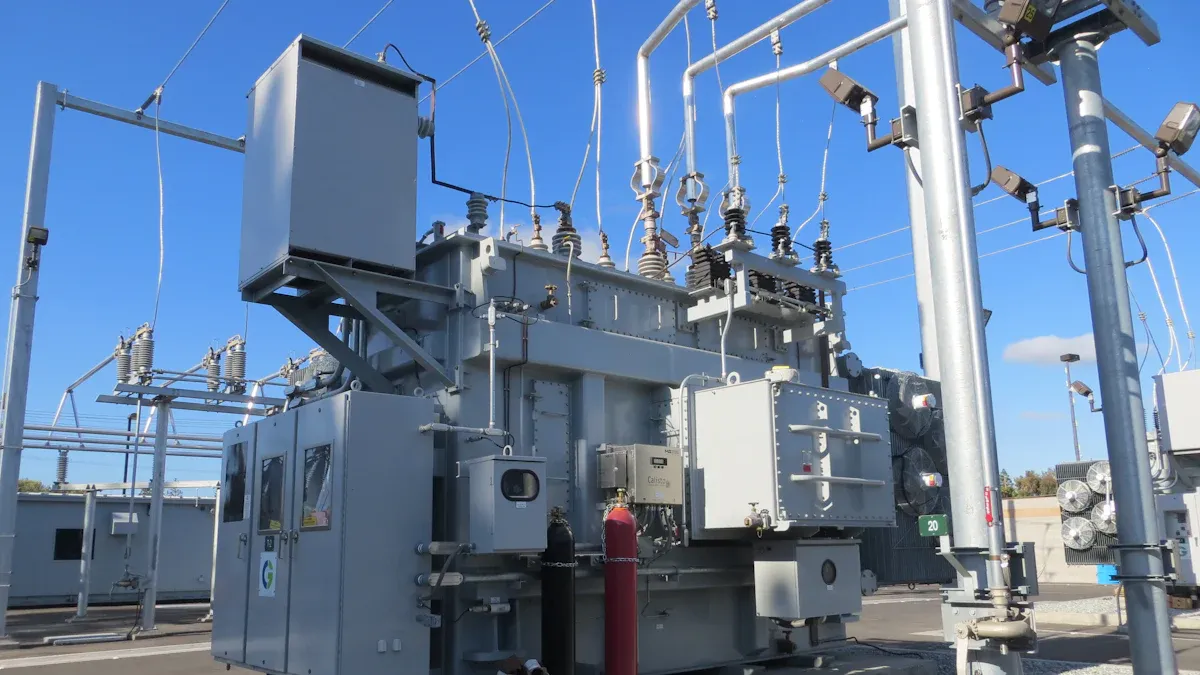
Image Source: unsplash
Real-Time Voltage Control
You need a power system that keeps voltage steady, even when demand changes quickly. On-Load Tap Changer transformers help you achieve this by adjusting the transformer’s tap position while the system stays energized. This process changes the number of turns in the transformer winding, which directly controls the output voltage. You get precise voltage regulation without interrupting your operations.
Here is how real-time voltage control works in practice:
Aspect | Description |
|---|---|
Purpose | Regulates transformer output voltage by changing the turns ratio through tap adjustments. |
Types | Two types: de-energized (off-load) and energized (on-load) tap changers. |
Monitoring Importance | Monitoring LTC condition is crucial to prevent failures and ensure efficient operation. |
A healthy On-Load Tap Changer generates very little heat when not switching. If you notice higher temperatures in the tap changer fluid, it may signal increased contact resistance. Electronic temperature monitors can alert you early, helping you prevent failures and maintain efficient operation.
You benefit from a wide voltage regulation range. In industrial applications, On-Load Tap Changer transformers typically offer a regulation range from ±10% to ±15%, with step sizes between 0.6% and 1.25%. This means you can keep your secondary voltage within ±5% of the nominal value, even as your load changes.
Load Adaptation and Stability
Your facility’s electrical load can change suddenly. When this happens, the On-Load Tap Changer responds quickly to keep voltage stable. Voltage sensors monitor the transformer’s output. If the load increases and voltage drops, the control system detects the change and decides if a tap adjustment is needed. The tap changer then increases the number of winding turns to raise the output voltage back to the desired level.
The tap changer detects changes in electrical parameters, especially output voltage.
Voltage sensors track the output and spot deviations as soon as load changes occur.
If voltage drops, the control system analyzes the deviation and triggers a tap change.
The tap changer adjusts the winding turns, restoring voltage stability.
This automatic response helps you avoid problems like equipment malfunction, insulation stress, or core saturation. You maintain a stable power supply, which is essential for sensitive industrial processes and commercial operations.
Tip: Regular monitoring of your On-Load Tap Changer’s condition ensures reliable performance and extends the lifespan of your transformer.
By using On-Load Tap Changer transformers, you gain real-time voltage control and fast adaptation to load changes. This technology keeps your power system stable, efficient, and ready for any challenge.
Ouxu Electric’s OLTC Transformer Solutions
Product Overview and Key Features
You want a transformer that delivers stable voltage, high efficiency, and long-term reliability. Ouxu Electric offers a range of On-Load Tap Changer transformer solutions designed to meet these needs in demanding environments.
Main OLTC Transformer Products:
35kV Double-Winding On-Load Tap-Changing Oil-Immersed Power Transformer
This transformer is ideal for small and medium-sized substations. It operates at 35kV and features a dual-winding design for high efficiency. The on-load tap changer allows you to adjust voltage in real time, keeping your power supply stable even when grid conditions change.
Learn more about the 35kV double-winding OLTC transformer.
Image suggestion: Photo of the 35kV OLTC transformer in a substation, optimized with alt="Ouxu Electric 35kV double-winding on-load tap-changing transformer in substation".Factory 10kV Three-Phase Oil Immersed On Load Tap Changer Transformer
This model is built for outdoor and industrial applications at 6kV and 10kV levels. It features a robust, fully sealed design that prevents oil leakage and reduces energy loss. The transformer provides accurate voltage regulation and operates quietly, making it suitable for both industrial and civil settings.
Explore the 10kV three-phase OLTC transformer.
Image suggestion: Image of the 10kV OLTC transformer installed outdoors, optimized with alt="Ouxu Electric 10kV three-phase on-load tap changer transformer in outdoor setting".Wholesale 35kV Double-Winding On-Load Tap-Changing Oil-Immersed Power Transformer
This transformer is designed for flexible deployment in small substations and utility-scale projects. It offers high efficiency, strong resistance to short circuits, and precise voltage regulation.
See details about the wholesale 35kV OLTC transformer.
Image suggestion: Product photo of the wholesale 35kV OLTC transformer, optimized with alt="Ouxu Electric wholesale 35kV double-winding on-load tap-changing transformer".
Key Features and Advantages:
Feature | Benefit |
|---|---|
Real-time voltage regulation | Keeps your voltage stable under changing load conditions |
High efficiency | Reduces no-load and load losses, saving energy and lowering costs |
Fully sealed design | Prevents oil leakage and extends insulation life |
Strong short-circuit resistance | Increases reliability and safety |
Wide environmental adaptability | Operates in extreme temperatures and high altitudes |
Quiet operation | Meets strict noise standards for sensitive environments |
You benefit from advanced control and monitoring systems. These systems allow you to regulate voltage precisely, even when loads change quickly. Ouxu Electric’s OLTC transformers stabilize voltage, reduce technical losses, and help you comply with utility voltage limits. Dynamic voltage regulation ensures your equipment runs smoothly and safely.
Note: Regular oil sampling, contact inspection, and monitoring of switching operations help you maintain peak transformer performance.
Application Scenarios
You can deploy Ouxu Electric’s OLTC transformer solutions in a wide range of industries and environments. These transformers support your operations wherever voltage stability and reliability matter most.
Common Application Areas:
Industrial manufacturing plants
Renewable energy systems, such as solar and wind farms
Utility-scale power distribution networks
Data centers and IT infrastructure
Oil and gas facilities
Mining operations
Pulp and paper mills
Steel production plants
Remote areas with unstable grids
You will find these transformers in environments that demand continuous, stable power. For example, automotive parts factories in Europe use Ouxu Electric’s OLTC transformers to expand production lines without risking voltage instability. Data centers rely on precise voltage control to protect sensitive equipment. Renewable energy sites use these transformers to manage fluctuating input from solar or wind sources.
Ouxu Electric’s OLTC transformers adapt to both indoor and outdoor installations. They perform reliably in harsh climates, from freezing cold to extreme heat, and at altitudes up to 2500 meters. Their robust construction and advanced features make them a trusted choice for critical infrastructure.
Tip: For more real-world examples, see how Ouxu Electric’s OLTC transformers support industrial manufacturing in this case study.
You can count on Ouxu Electric’s On-Load Tap Changer transformer solutions to deliver stable, efficient, and reliable power—no matter where you operate.
Tap Changer Operation and Components
Image Source: pexels
Switching Mechanism
You rely on the tap changer to adjust voltage without interrupting your power supply. The switching mechanism inside an On-Load Tap Changer (OLTC) transformer follows a precise sequence to ensure smooth operation and protect your equipment. Here’s how the tap changing process works:
Switch 3 closes. This is an off-load operation that prepares the system.
The rotary switch turns, breaking one connection. Load current now flows through diverter resistor A.
The rotary switch continues to turn, connecting contacts A and B. Load current splits between diverter resistors A and B, and winding turns are bridged.
The rotary switch moves further, breaking contact with diverter A. Load current now flows only through diverter B, and winding turns are no longer bridged.
The rotary switch keeps turning, shorting diverter B. Load current flows directly through the left-hand connection, and diverter A is out of use.
Switch 2 opens, completing the off-load operation.
This sequence allows you to change the transformer’s tap position while the system remains energized. The voltage adjustment process starts when you measure the actual secondary voltage under load. You compare this value to the required nominal voltage, calculate the percentage adjustment needed, and select the correct tap position. When the incoming voltage drops, the tap changer moves to a lower voltage setting, disengaging sections of the primary winding. This action increases the secondary voltage and corrects the voltage sag.
Tip: Regular inspection of the switching mechanism helps you prevent contact wear and ensures reliable tap changes.
Oil Immersion and Cooling
Oil immersion plays a vital role in OLTC transformer performance. The transformer oil surrounds the tap changer and windings, providing multiple benefits:
Function | Description |
|---|---|
Electrical Insulation | Oil offers excellent insulation between live components |
Cooling | Oil absorbs and dissipates heat from internal parts |
Protection | Oil shields components from moisture and oxidation |
You depend on oil immersion to keep your transformer cool and safe. The oil not only prevents overheating but also extends the lifespan of internal parts by reducing oxidation and moisture exposure. Always monitor oil quality and levels to maintain optimal cooling and insulation.
Note: Clean, well-maintained oil ensures your OLTC transformer operates efficiently and safely.
Maintenance and Monitoring Best Practices
Inspection and Oil Management
You need to keep your OLTC transformer in top condition to ensure reliable voltage regulation. Regular inspection and careful oil management help you avoid unexpected failures and extend the life of your equipment. Many maintenance challenges can arise, but you can prevent most of them with a proactive approach.
Maintenance Challenge | Symptoms/Diagnosis | Prevention Measures |
|---|---|---|
Contact Wear | Measure contact resistance; thermography under load; compare loss values | Replace contacts per OEM schedule; limit unnecessary tap changes; maintain oil quality |
Switching Arcing and Arc-Related Damage | Visible arcing; oil darkening; elevated combustible gases; erosion on contacts | Replace arc contacts and oil per OEM interval; set voltage band to reduce tap changes |
Oil Degradation and Contamination | Dark/cloudy oil; reduced dielectric strength; sludge in oil | Regular oil testing; seal maintenance; moisture control |
Mechanism and Drive Failure | Tap changer does not move; unusual noise; erratic tap changes | Lubrication and inspection per OEM schedule; replace worn parts |
Position Indicator and Wrong Tap | Displayed position does not match actual; inconsistent secondary voltage | Verify position after every tap change; calibrate position sensor |
You should follow a regular inspection schedule to catch issues early. Here is a guide for inspection intervals:
Inspection Type | Recommended Frequency |
|---|---|
Visual inspection | Daily to monthly |
Operational inspection | Monthly to quarterly |
Oil sampling and laboratory testing | Every 6–12 months |
Electrical testing | Every 1–5 years |
Comprehensive condition assessment | Every 5–10 years |
Continuous online monitoring (critical transformers) | 24/7 |
The insulating oil affects the transformer’s service life by preserving the dielectric integrity of the insulation system, dissipating heat from windings, preventing moisture accumulation, and indicating internal faults through dissolved gases. Degraded oil leads to increased acidity, reduced breakdown voltage, sludge formation, and accelerated insulation aging, which shortens the transformer’s operational life.
Ouxu Electric supports you with detailed maintenance guides and after-sales service plans. You receive regular follow-up visits, technical support, and clear instructions for oil management and inspection routines.
Condition Monitoring Technologies
Modern OLTC transformers use advanced monitoring technologies to help you spot problems before they cause failures. You can use these tools to track the health of your transformer and plan maintenance at the right time.
Fiber optic sensors measure winding temperatures directly and resist electromagnetic interference.
Advanced dissolved gas analysis (DGA) detects early faults by analyzing gases at very low concentrations.
Ultrasonic sensors pick up sounds from partial discharges or mechanical issues.
MEMS technology allows for small, precise sensors in new locations.
Wireless sensor networks make installation easier and reduce wiring.
Edge computing processes data locally for faster alerts.
Cloud integration connects your transformer to advanced analytics and remote monitoring.
AI and machine learning help you recognize patterns, predict failures, and combine data from many sources for better diagnostics.
Temperature sensors and other monitoring devices play a key role in preventive maintenance. They help you detect changes in condition weeks or months before a failure. By tracking thermal parameters, winding hot-spot temperatures, and contact resistance, you can focus your maintenance efforts where they matter most. Operation counters and oil quality sensors also help you schedule service at the right time, reducing unnecessary work and costs.
Ouxu Electric’s after-sales support includes guidance on using these technologies, ensuring you get the most from your investment and keep your power system running smoothly.
Case Study: Ouxu Electric OLTC in Industrial Manufacturing
European Auto Parts Factory Solution
You face many challenges when expanding production in a modern auto parts factory. In one European facility, the existing transformer could only support two production lines. Adding more lines led to voltage instability, which threatened both equipment and output quality.
Challenge Description | Impact |
|---|---|
Existing transformer can only support two production lines | Leads to voltage instability when adding new lines |
You need a solution that fits tight spaces, meets strict noise standards, and delivers reliable voltage. Ouxu Electric provided a custom On-Load Tap Changer transformer designed for compact installation. The transformer featured a flat-core and compact windings, saving 35% of space. It operated at a low noise level and included an intelligent temperature control system for real-time monitoring. The design met CE certification and German noise emission standards.
Note: You can see the product details and technical specifications for similar solutions on the 35kV double-winding OLTC transformer page.
Image suggestion: Photo of the installed transformer in the factory, optimized with alt="Ouxu Electric OLTC transformer in European auto parts factory".
Implementation and Results
You benefit from a fast and efficient installation process. Ouxu Electric completed the design, production, and delivery within 64 days, ahead of the customer’s deadline. The transformer passed all required tests, including noise and wear assessments.
After installation, you notice several improvements:
Enhanced power quality
Increased equipment lifespan
Reduced energy losses
You now run more production lines without risking voltage drops or equipment damage. The On-Load Tap Changer transformer helps you meet strict European standards and supports your growth. Ouxu Electric’s solution delivers long-term value by reducing maintenance needs and supporting efficient, reliable operations.
On-Load Tap Changer Transformers play a vital role in your power system. You gain:
Continuous voltage regulation for stable output
Protection from overvoltage or undervoltage
Improved transformer efficiency and reduced energy loss
Less risk of overheating and equipment damage
Ouxu Electric leads with innovation, quality, and expert support. You can keep your transformer reliable by following these best practices:
Best Practice | Description |
|---|---|
Structured Maintenance | Schedule regular inspections and oil tests |
Precision Diagnostics | Use advanced tools for early fault detection |
Team Training | Train your staff for better maintenance |
You meet industry standards like IEC 60214 and IEEE C57.131. For more solutions or support, contact Ouxu Electric today.
FAQ
What is an On-Load Tap Changer (OLTC) transformer?
An OLTC transformer lets you adjust voltage while the transformer stays energized. You get real-time voltage regulation, which keeps your power system stable during load changes.
How often should you inspect an OLTC transformer?
You should perform visual inspections monthly and schedule oil testing every 6–12 months. For critical transformers, use continuous online monitoring to catch issues early.
Can OLTC transformers operate in extreme environments?
Yes. Ouxu Electric’s OLTC transformers work in temperatures from -40℃ to +50℃ and at altitudes up to 2500 meters. You can install them indoors or outdoors.
What are the main benefits of using OLTC transformers?
You gain stable voltage, improved energy efficiency, and longer equipment life. OLTC transformers help you avoid voltage sags, reduce maintenance, and support sensitive industrial processes.
How do you know when to service your OLTC transformer?
Tip: Watch for unusual noises, oil discoloration, or voltage fluctuations. Use monitoring systems to track temperature and contact resistance. Schedule maintenance if you notice any warning signs.